The Plague of Words

Fear in the eyes,

Taunts and lies,

A dream spins over my sleeping head.

Words slippery and slimy,

Words hard and chunky,

Words sliding gleefully headfirst,

Free at last to do their worst.

Threats and Show,

How far will they go?

The mean one snaps,

The vague ones leave only gaps.

Joyful is leaping over the trees,

With Surprise bursting and popping in the breeze.

Over my sleeping eyes,

The light of the Moon-rise.

The Lie wriggles and changes shape

From Smile to Frown and then to Gape.

Who guards the world from these wild words?

When Brightness and Truth have flown like Birds,

Into the hazy Sky,

When will Morning be nigh?

These words are Fighting,

Stealing, Slighting

They drip like Poisons

They layer like Onions

Is that shadow hiding Peace and Truth?

Where is Science and its heavy friend Proof?

The rough warm texture in

Kindness and Connection?

They pull on my ears,

A plague of Fears.

They redden my eyes,

This plague of Lies

The moonlight whispers

Their secrets as I whimper.

Waiting for Daylight

And the end of the long Night.

(This is another poem I combined with a prompt from Vocal Media about a vivid full-moon dream. For some reason I find their prompts irresistible, even though everything written there goes into a huge slush pile of random stuff that’s very hard to navigate. I like this poem, however.)

A Floral Feud

Photo by Nadir sYzYgY from Unsplash

It was a long war. It had started with snails, moved on to weed seeds, weedkiller, then angry calls to the local Council complaints office, and, possibly, witchcraft.

The two competing territories were side by side in a row of tiny terrace houses. Originally the houses had been decorated with the latest fashions of 1880, with iron lace hanging like cobwebs from the corners of the porches and painted metal railings topped with fleur de lys blades to keep interlopers from stepping into the gardens.

Interlopers who presumably couldn’t figure out how to open the gate.

Every other house in the street had been adapted for modern living, with gardens converted to parking spaces, brick extensions or a collection of wheelie bins and dumpsters.

Denise’s garden was a masterpiece of order. In late summer, the neat clumps of flowering marigolds were hemmed in by taller cosmos and a clipped box hedge. A Comice pear tree was spreadeagled and pinned to make an espalier on the side wall, bordering a gardenless neighbour.

No weed grew past a centimetre in length before being snatched away by Denise’s hands. Bedding flowers were replaced on a rigid timetable, or as soon as they began to look frayed and tatty.

Next door was a different matter. Esther’s garden was a riot of colour and texture at any time of the year, even winter, when the rosehips and pomegranates dangled from bare branches. In the spring she began to scatter the seeds she had saved from the previous year, allowing calendulas, forget-me-nots and poppies to push up through the spreading thyme and make drifts of gold, or red, or blue.

She encouraged native grasses along her border with Denise, a very sore point, because when they self-seeded they were prolific. Even more offensive was the prickly bursaria bush which caught at the arms of passers-by and resulted in frequent complaints from the postal service. She hung coloured crystals and wind chimes from the decaying iron lace on the porch, adding to her reputation for witchcraft.

Esther didn’t deny it. “Naturally I’m a witch. I’m over fifty and a single woman. Back in the day, they’d have burned me at the stake. That skinny shrew Denise too, of course.” She liked to wear home-made tie-dyed peasant skirts that swished around her full figure, and lumpy hand-knitted shawls that made that figure a mystery.

Denise, on the other hand, liked to look “professional” at all times, even when wearing her smart leather gardening gloves and kneeling on her expensive padded mat, which relieved the pain in her aging knees as she worked her way methodically from one corner to the other.

The third house in the little row was one that had had the front garden converted into a small parking lot, with a side order of dumpsters.

The first Denise knew that the new neighbours had children was the sound of shrill crying at night. Very irritating.

Esther, being closer, saw the ride-on tractor among the wheelie bins, and greeted the harried mother with the toddler in a friendly way. The mother smiled back briefly, nervously, but didn’t make eye contact.

The older, skinny boy in a paper thin Superman t-shirt started leaning on the railing of Esther’s garden and asking her what she was doing.

“I’m saving seeds from these calendulas, now they’re getting ready to die back. Do you want some?”

“Awesome” said the boy. “Are they like watermelons, that will grow in my stomach if I swallow them? Or in my ears if I don’t clean them?”

“Who told you that?”

“My Dad. He knows lots of things.”

“Hmm.” Esther was not too impressed by the loud-mouthed strutting father, who had run over the toddler’s toy tractor on the third day. “Ask your parents if you can come over and I’ll show you some other things in the garden.”

The boy ran inside and got a careless wave of permission from his mother. From then on, he was in Esther’s garden every afternoon instead of riding his bike up and down the footpath in front of the house, occasionally scraping the cars parked with their wheels up on the kerb.

On Saturdays, Esther went to visit her sons and then on to her meditation group. That was the day that Denise was home from work and had an extended session on patrol in her garden for weeds.

She found a narrow, big-eared face staring at her through the railing. “Who are you?” she demanded.

“I’m Rory,” said the boy. “I like your garden. It’s really neat.”

Perfect words for a perfectionist. “Well, I’m not sure my chrysanthemums are doing well this year. I’ll have to chop them back harder this winter.”

“Do they like that?”

“Some things won’t grow properly without being chopped back regularly. They actually seem to like it.”

“Can I help?”

Surprising herself, Denise made sure he had permission, then watched carefully as he pinched out tiny grass seedlings between the pavers. “You’re great at that,” she said. “Most kids aren’t as tidy as you.”

“Would you like some calendula seeds?” Rory offered the little handful he’d been keeping in his pocket.

“Hmm. It’s not really the right season. Let’s put some in a jar for later, and put a few in a pot and see if they grow.”

The neatly coiffed grey head bent low next to the tousled one as they carefully planted and watered the seeds into potting mix.

“Do you want to take it home?”

Rory hesitated. “Things at home tend to break,” he said.

“Then we’ll keep it here.”

Surprisingly, the out of season calendulas began to grow on Denise’s sunny porch despite the cooling season.

One Saturday Esther was running late as she hunted for her bag of treats for her sons when she saw the seedlings. She looked at Denise.

“I see you’ve come around to using calendulas as well as your other marigolds.” she said.

Esther was horrified to realise that the flowers had come from the Garden of Evil next door. Perhaps she would have done something foolish with the pot, except that Rory appeared, beaming at both of them.

“Hello Denise. Hello Esther.”

They greeted him, eyeing one another sideways cautiously.

“Isn’t it a nice day to be in a garden?” said Rory. “Everyone in a garden can be friends, can’t they? It’s all so beautiful.”

Somehow both women found themselves agreeing, for the first time ever.

It must have been witchcraft.

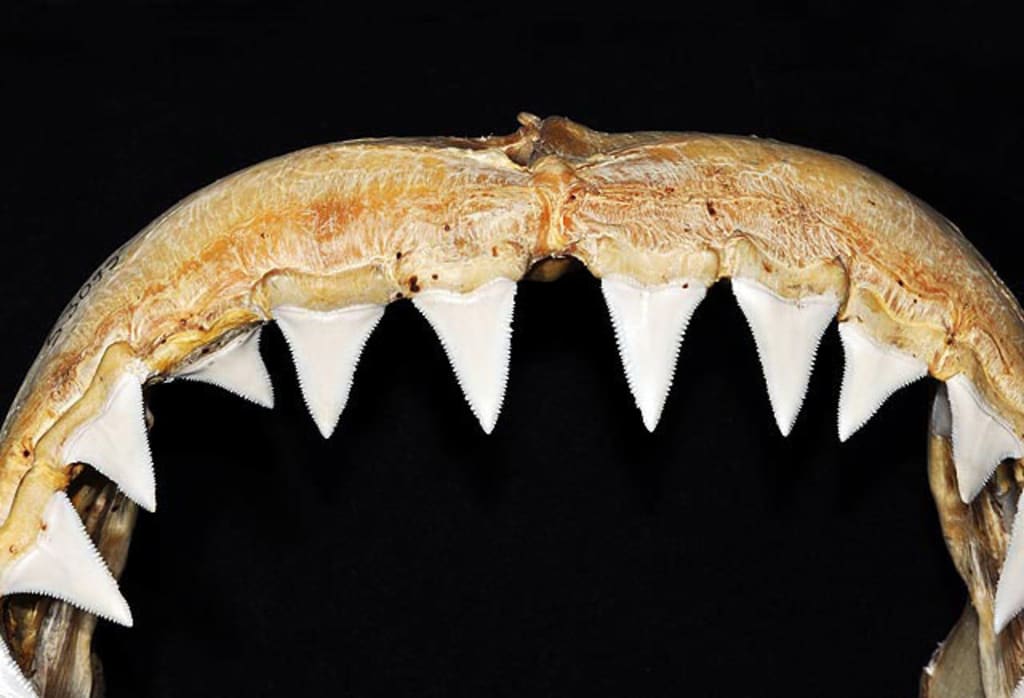
Shark Tooth

(This is another short story from a Vocal Media prompt about sharks.)

A biological romance

Photo by D Ross Robertson – http://biogeodb.stri.si.edu

“You know this was all an ocean once, don’t you?” Jake’s voice breaks the silence.

“This desert? It’s pretty dry now. Especially if you’ve drunk all the cider. Did you drink all the cider?”

He hands her the shared bottle, as warm as the night. “About four million years ago, it was all sharks and crocodiles and fish right here. And plesiosaurs before that.”

“The Loch Ness Monster was here?”

“Yep. One maybe swam right here and sat on a stromatolite. That’s what those knobby rocks are, or were. And before all that, the stromatolites ruled the oceans, all over the world”

“Huh. Quite a comedown, to knobby desert rock.”

“I guess.”

There’s silence and Jenna sips at the bottle of cider to cover the awkwardness. Jake looks at her uncertainly, not sure if this is The Moment, or not.

The campfire flickers and there’s raucous laughter from the big group below the rocky ridge where they are sitting. Ricky has brought out his guitar. Jake wishes he had something talented and impressive like guitar skills. The group laughs at something witty Ricky’s said. Witty would be good, too.

“Did I show you my shark tooth?”

“What are you, a surfer boy?”

“Not really. I was at the beach last week and it washed up under my hand. I brought it with me because I thought you might like it.”

“Huh.” As the tooth passes into Jenna’s hand, he wonders if she feels the same static charge that he does from that momentary touch. “It’s smooth. I thought shark teeth were all jagged, like a saw.”

“This one’s a fossil. It’s been in the ocean for hundreds of years, I don’t know, maybe millions, picking up minerals.”

“Nice.” She tries to hand it back to him, but he waves it away.

“You have it. You could, maybe, put it on a necklace or something.”

“You should keep it. You found it. You’d look good in a necklace.”

“No, no”. This isn’t going at all the way Jake had envisioned. Maybe he should wait until tomorrow. But tomorrow will be another day of dust and hot sun while his group samples for biological life in the endless salt pans, and Jenna’s group sits under shady hats swatting flies while they sketch geological formations for their art class. And the next day they’ll be moving on, separately.

“Shark lose lots of teeth,” he finds himself saying. Oh, great. More shark facts. “They have rows of them, so when one falls out, the next row moves up.”

“Would save on brushing. I guess.”

“They don’t need to brush. Not that they could. Of course not.” Jake tries a laugh. “Their teeth are coated with fluoride, so even if they get stuff caught in them, they don’t go rotten and smelly.” Worse and worse, now he’s talking about disgusting teeth. Are his own teeth rotten? Did he brush them this morning? Did the onion in tonight’s chili give him bad breath?

“That’s awesome. I wish I had teeth like that. I think that chili gave me onion breath. If I was a shark, I could just let them fall out and get a new lot. Like my Grandma. She has a whole set of falsies. Maybe she could use this one? That’d be a look.” Jenna laughs and holds the triangular tooth so that the moonlight catches the sheen and the shape of it. “It’s amazing to imagine something so old just lying on the sea floor.”

Jake laughs too. This is better.

Jake dares to touch the tooth in her hand, running his finger around the outline of it lying in her smooth palm. “It’s a White Pointer tooth. You can tell by the shape. The ocean that was here, the Eromanga Sea, it would have had even bigger sharks, Megaladon. One of their teeth would be the size of your hand.”

He slides his hand over hers and leans forward.

She leans back, pulling her hand away. “Wouldn’t want to meet one of them.”

Jake takes a breath, leaning back again. This was not The Moment, then. And it might never come at all.

There’s another burst of laughter from the shadows around the campfire.

But she doesn’t leave.

“They were like whales, enormous.” Shark facts, again.

“I wonder what they’d say if I put them in my paintings. Desert with floating fish. The sand dune ripples already look like the sea floor.”

“That’d be amazing. You’re an amazing artist.” He’s seen what she does with paint, far and away better than any of the other art students.

“Oh, you’re the art expert, are you?” She shoves his shoulder. His skin warms there. Thank goodness she can’t see him blushing in the dim light.

“I know what I like. Your pictures look like something, not just, you know, a mess of stuff.”

“You mean I’m a literalist. I paint what I see.”

“Not if you include fish in the desert.”

“I’d be painting their echoes, what was there once.”

“Echoes. Yeah. I never thought of it that way. That’s what we are, maybe even some parts of us were part of that sea, and we’re, sort of, their descendants in a way.”

Satisfied that when she pushed him away, Jake didn’t make himself obnoxious like that prat Ricky, Jenna smiles and strokes his face with the worn tooth, it’s smooth blade sending all his nerves tingling again.

She takes it away.

“Kiss me, you nitwit.”

Startled, he does.

Later, fingers interlaced, they lie back looking at the ancient stars, and feeling the invisible ocean above them reflecting in their eyes.

All Homes are Different (But the Same)

(This poem I sent to Vocal Media for a competition about “what home means to me”. They encourage the use of images with the words, which I found irritating, sometimes clunky and a very clickbaity at first, but then I got into it, and now can’t see this particular poem any other way.)

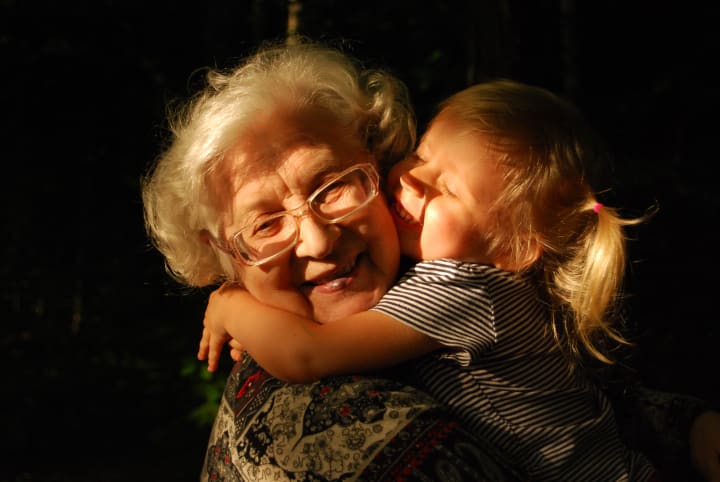
A smile

A hug

Food

And shelter.

Photo by Cathy Mu on Unsplash

Sailors on the boundless ocean: ‘This is our home.”

A woman strokes the spindly tree where she was born: “This is my home”

A dispossessed man beats the dust where a new road slices ancient landscape: “This is my home”

Under tin roofs, thatch, or tile, people still hope

For a smile

A hug

Food

And shelter.

Photo by Ananya Bilimale on Unsplash

Yellowing paper files or the clacking keys of computers keep records as flimsy as dreams,

A tent in the desert, a castle in Spain, “This is their home”

The high-rise honeycombs of modern caves, watching flickering shadows on paper-thin walls: “This is their home”

Astronauts stare in wonder at a blue orb suspended in space: “This is our home”

A building is no more than sticks and mud

With no one there to care

No one to say “This is our home”

Sure of a smile

A hug

Food

And shelter.

Photo by Jimmy Dean from Unsplash

We are all renters under the stars.

We can claim “This is ours”

But we stay only a little while,

A day, a year, a lifetime.

Paying our dues to those before us,

Passing what we can to those who come after,

A smile

A hug

Food

And shelter.

Photo by Ekaterina Shakarova on Unsplash

So they can say, too, one day “This is our home”

All homes are different but the same

Photo by NASA on Unsplash

DECLUTTERING

How the past sets traps for the future to find

(Photo by MChe Lee on Unsplash)

“There’s something else here!” Mia tugs on the pile of old man clothes in the musty closet. It collapses, dusting her dark, curly hair in a waft of mould and dust. She emerges clutching a brown-paper wrapped package, shoe-box sized.

“Did you have to do that?” asks her mother, Charlotte. “I’d just cleared that space.”

“It’s addressed to Grandma, but it doesn’t look like it’s ever been opened.” Mia turns it over and over in her hands, shakes it, picks at the string.

“Could you just focus, Mia? We need to at least get the clothes out of here before Goodwill closes.”

“I can’t tell who it’s from, the sender address is all blurry. But it’s definitely Grandma’s name, and it rattles.”

“Just grab those bin bags, will you? I don’t know if any of this is saleable. Perhaps we should wash it all to get the mustiness out before we give them away?”

“Ohhh, that’s gorgeous.” Mia holds up a dress made of shining sequins with a low swooping back “I never knew Grandma had anything like this. Can I keep it?”

“Why not? She was pretty hot in her day, so she always told me. Frequently. But she had to settle down when she got married, that’s what you did in those days. Had kids, gave up all the fun.”

“Like you, Mum? Don’t you have any fun anymore?”

Charlotte shakes her own curly head at her daughter. “I do, because I never took that bargain. I thought it was a crummy one. And I told your father so, and he agreed. But we both plan to do some extreme kicking up of heels when you go to college, let me tell you.”

Mia stares, imagining this idea with horror. Old people kicking up their heels! “Ergh. The underwear goes out, right?”

Charlotte is back to stuffing bin bags with old coats and trousers. “Yep. No one wants that.”

“Wouldn’t it be easier just to keep it all? Then we wouldn’t have to pick and choose.”

Charlotte shakes her head “Even the underwear? And where would we put it all?”

“Storage unit?”

“And you’d pay for that would you, for a lot of old stuff, more than half of it rubbish?”

“Vintage?”

“Not even. Look, here’s the list of things that have a valuation, from back when your Pop went into the nursing home. See if you can find them all.”

Mia takes the list, and the package, still rattling it curiously from time to time. She finds the seed pearl necklace, the cameo brooch, the engraved silver tray and the gold and ruby ring, which for no obvious reason brings tears to her eyes, remembering it on Grandma’s finger. The most valuable thing on the list is :

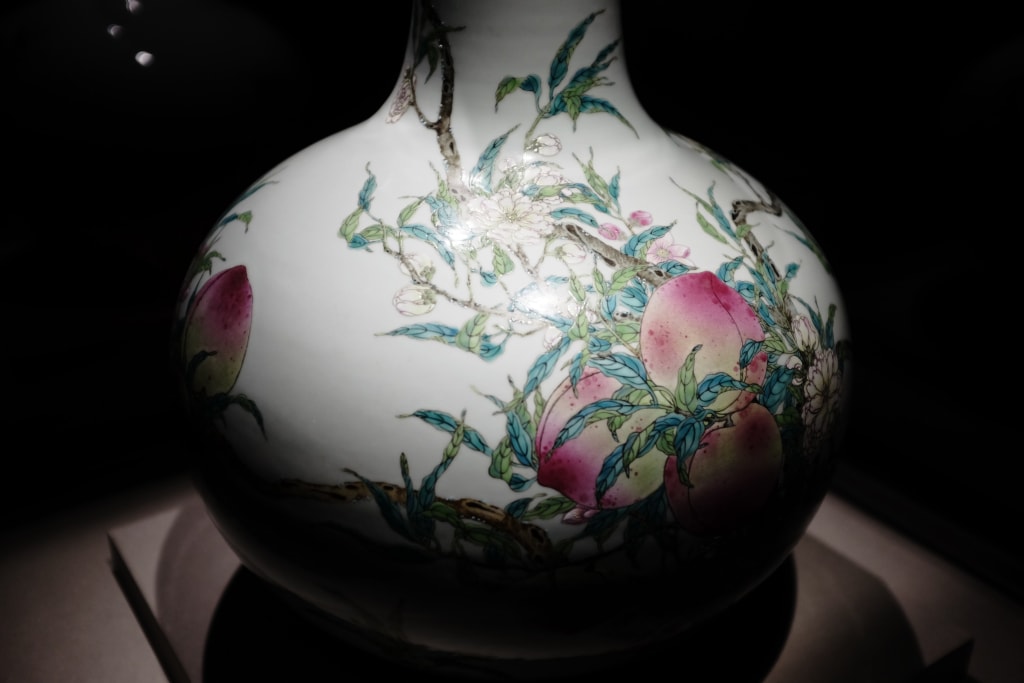
“A pair of famille rose white ground vases featuring peaches and peonies (Yongzheng four-character mark in iron red and of the period (1723-1735). 6in (15 cm) high.”

“What’s a “famille rose” vase Mum?” she asks.

Charlotte waves at the mantelpiece. “There it is. Be careful.”

The vase is a beautiful thing in gold and pink and red, an intertwining pattern growing around it with clusters of peaches on one side and a group of peonies on the other.

Charlotte comes over “You have to hold it firmly, don’t let it slip. That’s what Pop always told me.”

“Wow, it’s gorgeous,” Mia breathes carefully in case it breaks.

“The peaches mean fertility, and peonies are for wealth. I think it was a wedding present, for good luck, I guess. Pretty fancy compared to everything else they had. Mum never said who it was from.”

They admire it for a while, then Mia asks “Where’s the other one? It says a pair on the list.”

“I remember it did have a pair. I haven’t seen the other one for a long time. Maybe it broke? What a shame. I suppose that’ll drop the value quite a bit.”

“Is that all you care about?”

“Look at the estimate. Frankly, we could use the money. For your college fees, among other things.”

Silenced temporarily, Mia makes up a new box and wrapping paper for the valuables, then finds herself picking at the mystery package again. The old brown string is twisted tight and wadded with dust. It’s obviously never been opened in all the years since it was tied. Finally, she takes a knife from the kitchen and cuts it, pulling the paper away and opening the lid.

The inside is packed with cotton wool. Nothing seems to rattle. Mia burrows into it with her fingers, looking for anything else she can find. Surely this can’t be all? A sharp piece of pottery stabs her finger, then another. She pulls all the cotton wool out, to find seven broken pieces of porcelain altogether.

“Mum!” she shrieks “It’s the other vase. It was in that box. But it’s all smashed up.”

Charlotte takes the one of the pink and white pieces gently. “What a pity. I wonder how that happened?”

“We can fix it. I’ve got superglue at home.’

“No, it needs a professional. But I don’t know if it’s worth it.”

She starts putting the pieces together into a rough shape.

Mia rustles around in the box some more. “There’s a letter!”

It’s just a card, really, very short, in sharp stabbing handwriting.

“Dear Sal,

I’m sending this back to you, even though you threw it at my head, because I know you treasure it as you do not me.

With love,

Terence”

“She threw it at his head? Way to go, Grandma.” Mia is impressed.

“I don’t remember ever hearing about a Terence. How strange.”

“I wonder why she never opened the parcel?”

“Leave it, can’t you? We need to finish emptying these closets.” Charlotte gets up abruptly.

Later, while Charlotte takes a carload of the better clothing to the Op Shop, Mia is left to keep sorting. The bedrooms seem very empty, with ugly stains showing on the old fitted carpet, while the kitchen remains chaotic with random objects spread across every surface.

Mia looks back at the puzzling box.

A mystery package, from a mystery man. A package that was never opened.

She pulls out one of the boxes Charlotte set aside for looking at later. One is full of plastic photograph albums, reddened pictures of strangers grouped together and smiling for the camera. Several of Pop with his thin face and fair hair, looking crumpled as he always did, even as a young man with hair on his head.

There’s Grandma in a pillbox hat with a silly-looking veil flung back, swinging on Pop’s arm as they come down the steps of a church. She’s looking straight at the camera, confident and sassy, not like the small, hunched figure of recent years. Her eyes seem so bright.

Lots of photos of Mum and her little brothers on the beach waving buckets and looking sunburned and sandy.

Under the albums are some home video tapes, but the packets crumble in her fingers and it’s impossible to read the scribbled descriptions.

Charlotte comes back, sighs at the new mess, dumps the decayed tapes in a bin bag. “No way those will play. Pity she didn’t get them transferred years ago. That’s how it is, the past goes, and it’s gone. No point dwelling on it.”

There are some bundles of letters, yellowed and water-stained from a long-ago accident. None of them are from the mysterious Terence.

At the very bottom, a small black and white album with pictures of Grandma as a child, wearing an Alice band, riding a bicycle, posing in the shining fishtail dress. “Look Mum, there’s that dress!”

Charlotte smiles. “I remember her showing these to me, once. Your Pop wasn’t very keen on memories. He was more like me, a chucker-outer.”

As she’s closing the album and putting it away, a small loose photo slides out . It’s black and white, of a man leaning on a car smoking a cigarette.

Charlotte draws a breath.

Mia turns it over. In looping writing on the back is one word “Terence”.

“It’s him! It’s the mystery man.”

She pulls her phone out and zooms in to see the details. A striking face with dark curling hair looks back at her, rather arrogant, one eyebrow raised.

“Are you okay, Mum? You’ve gone all funny-looking.”

“I saw this man once. Mum was really angry with him that he came to the house. He was wearing a suit, all fancy. Not like any of the people we usually saw.”

“So, you met him? What was he like?”

“I don’t remember much. He patted me on the head and I was annoyed, because I didn’t like to be treated like a baby, even though I was one, practically, of course. He said “You know I can’t keep away.” But my mother said “You have to. Go.”

Mia stares at the photo some more. The face looks somehow familiar. That curling hair, those dark eyebrows.

“He did go away. I asked her why she was so cross, but she said “That’s grownups business, not yours.” I guess he must have come back sometime later, because I remember the two vases from before that, but not afterwards.

“Woah. Was Grandma having an affair? That’s pretty wild.”

Charlotte puts her hand over her mouth. “Oh my. Oh, poor Mum. Was she?”

“How mental is that, if she was.” Mia starts to laugh.

Charlotte looks again at the photo and pulls at her own dark, curly hair, her square chin, her dark eyes. “Oh, lord. This is why I never wanted to ask.”

“Totally mental.”

“It explains so much. This wasn’t a happy house then. There were lots of late-night seething conversations. Doors slammed. Voices raised.”

“You think Pop and Grandma were unhappy?”

“I don’t know. Maybe. It got better later, when I left home and it was just the boys. Then after the boys grew up, my parents started travelling everywhere, cruise ship after cruise ship. “Sailing away from life” Mum used to call it. Maybe this was why.”

“And she never said anything about Terence?”

“Never.”

“You know, this box was with Pop’s things. Not Grandma’s.”

“You’re right. It was.”

“So maybe she never knew it was there. Pop took it and hid it. Why would he do that? Why not throw it away?”

“Who knows? It’s all ancient history now.”

“But we should find out.”

Charlotte shakes her head. “That story’s over. It’s done and gone. Let it rest.”

She turns away so that Mia doesn’t see the tears in her eyes.

Mia’s dark curls bob as she fiddles the pieces of pottery into their ancient shape. “I never thought of Grandma as a person before. She was just Grandma. So many questions we didn’t even know enough to ask.”

“And answers she never would have given.”

The daughter and grand-daughter go back to clearing away the past.

WHERE IS LOLA?

Read this story on Vocal. Some of my friends may recognise a few of the characters…
WHERE IS LOLA?

(Photo by andrew welch on Unsplash)

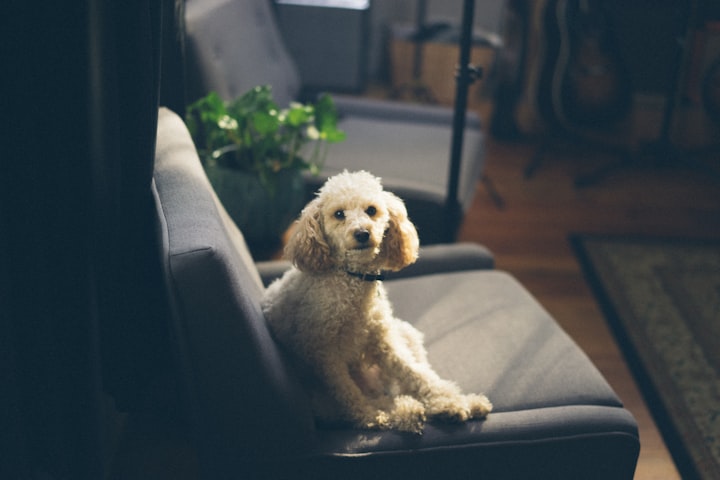
I don’t know where Lola is. I’ve sniffed everywhere. Upstairs. Downstairs. In the shoe cupboard.

I go back to sitting on Len’s large stomach. He pats me, but there’s no talk of “Walks!” or “Let’s play tug of war!” He doesn’t wander around the house so I can follow him just to see if something exciting is going to happen.

His eyes are grey and still, like the pond in the garden under midwinter ice. I prefer the pond in summer when I can plunge in and fling the pondweed about while I chase the goldfish. Lola hates it when I come inside with muddy feet, though.

Doesn’t Len care that Lola isn’t here?

There’s a thump on the door and a bang on the porch. I take a flying leap from Len’s stomach onto the rug and then launch myself at the windowsill. Lola doesn’t like it either when I knock down her china ornaments, but it’s far too important to see what’s going on to worry about that today. Or any day.

A parcel! A big box-shaped parcel wrapped in brown paper. On our porch! Len! Len! It could be anything! Come and see!

Len just scratches his stomach and sighs.

Len! That’s the doorbell!

I scrabble at the inside of the door to get a sniff of the new arrivals.

It’s Ken! Len, Ken’s here! Ken’s here!

Maybe Ken knows where Lola is. Last I saw her she was looking very sad and I’m worried about her. Her lap had gone all bony and uncomfortable under the fluffy dressing gown, but I still liked to be with her.

Len finally gets up, making that weird groaning noise he does these days. I run back and forth to the door just to make sure he doesn’t get confused and go to the fridge instead.

He does go to the fridge, but he opens the front door first. “Hey Ken.”

He offers Ken a beer and takes the top off another for himself.

“Yeah, not for breakfast, bro. Bit early for me.”

Ken smells a little of my sister Bitsy. His face is just like Len’s but he mainly smells like the weird apple shampoo Cherie makes him use. Ken hasn’t been using any shampoo at all lately, so even though they’re twins they’re easy for me to tell apart at the moment.

Where’s Bitsy? Maybe she’s seen Lola.

I sniff outside, but Bitsy isn’t here. Ken brings in the package from the porch and puts it on the kitchen bench.

Len leans back against the bench with his beer. “Whatever your plan is, it’s not going to work,” he says.

I can tell Ken is disappointed. It would be so much easier if humans had ears and a tail to droop, but I’m a smart poodle, and I can tell when something’s not right.

Like Lola being missing.

“Wait and see.” Says Ken. He undoes the box, and there are two more boxes inside. I know what’s in here, I can smell it! But Len doesn’t know yet. Human noses just aren’t very good.

“I hope they aren’t squashed.”

He opens the first box. “Ta-daah!”

It’s a huge luscious chocolate cake, with swirls of brown and white icing.

“I thought about how much Lola liked chocolate cake, and I thought maybe she shouldn’t miss out this time. After last time was such a mess.”

Len just stands there, staring at it.

Ken closes the lid and opens the other box. There’s another identical-looking cake, but I can tell it’s different. Even with all the chocolate from the first cake filling the air, it’s…meatier.

“And Ta-daah Cake Two!”

Len finally speaks. “We don’t always have to do things in twos, bro. We’re past the age of Double Trouble.”

“No, you don’t get it, this one looks the same but it’s dog-friendly. It’s made from kibble and carob, with extra carob frosting. “

Len frowns “That’s ridiculous.”

“Don’t be a spoil sport. I spent hours down at the bakery getting them to make these. Cherie’s bringing the whole gang and a picnic, and we’re all going to see Lola. I just wanted you to get a preview. “

Ken, helped by me, manages to chivvy Len into a clean shirt, taking the old shirt away with a “P-euw, brother when did you last change this?” I drag it to the corner where I might nap on it later.

Then we’re in the car.

We’re going to see Lola! Lola!

Lola’s face should be the first thing I see every morning, bright and smiling and trickling delicious crunchy kibble bits into my bowl. I loved to ride in the car with her, until people started shouting at her for letting me ride up on the dashboard and she made me sit in the back seat.

The car window’s up, so I can’t really tell where we’re going. There are trees, houses, a squirrel! Drat, I can’t get at it. There are flyers taped to all the power poles along this street. Maybe they’re for Lola? But the pictures are of dogs and cats, and some are just writing. As I’m straining to see, we jerk into movement again. The traffic light has changed from red to green, and then we’re turning into some gates.

It looks like a park, lots of grass and a few trees and benches.

Ken opens the door and I’m off. I can see Bitsy! Bitsy! I’m here! I’m here! Come and sniff me! I’ll sniff you too!

Bitsy and I zoom around while Cherie sets up a table with a yellow tablecloth and flowers and corn chips and salsa. I don’t really like corn chips, but it’s worth keeping an eye on in case the humans wander off and there’s an opportunity.

I can see more people coming. It really is the whole pack! Rufus the Airedale with his humans is bouncing over the rocks and almost upsetting the table.

“Get out of it, Rufus!” says Cherie, between breaths blowing up balloons.

Rufus is famous for chasing down a huge bull at the show, where he was supposed to be doing an Obedience Competition, walking along the top of ladders and going through tunnels and jumping gates, but he got out and face to face with the bull. His poor humans spent months training him then he leaves them looking red-faced.

I would never do that to Lola or Len.

But Lola has left me.

I don’t think she’s chasing a bull, though.

Or that she’d bite one on the balls and do “thousands of dollars-worth of damage” like Rufus did, either. Not really her style.

She was more prone to wafting around with a marigold in her hair, leaving trails of that scent that has flowers and…and…

Am I forgetting her scent?

I ask Bitsy if she remembers Lola’s scent, but she says everything at her house smells of the awful apple shampoo and it’s spoiled her nose forever.

There’s short-legged Sizzle, with his humans. I wonder if there will be barbecued sausages today? Sizzle doesn’t like it that humans are always making jokes about sausages with him around. Oh, yes, look, his humans have brought a portable grill and they’re bringing out the tongs.

It’s not that he doesn’t like sausages, it’s that they hardly ever give him any. “Cannibalism,” they say, and laugh.

Ken has managed to get Len out of the car, across the grass and into a camping chair. Len was so unwilling, I thought Ken might need to use Bitsy’s flowery leash

And finally, Maigret the basset hound is dragging his humans across the grass towards us. He’s zigzagging around, hot on the trail of a squirrel that I can see shaking his tail at us from the top of a big tree. His nose is very good, but he’s always well behind whatever he’s chasing.

The thing is, I don’t see Lola. Where can she be? Maybe Maigret can find her. He’s a great detective, so his humans say.

The humans are getting into the drinks with some enthusiasm. They don’t seem to be looking for Lola at all. They talk about her a lot, though: “To Lola!” they say, and pop another loud cork from a fizzy drink.

Rufus is busy telling us all about his adventure with the bull, for the fiftieth time. “I bit him right between the legs, the dangly bit, just like this!” he says and snatches at one of the yellow balloons tied to Len’s chair.

It bursts with a pop and Rufus is left yelping with yellow rubber on his nose.

“Get away from that, you great galumphing brute,” say his humans, but as usual he doesn’t listen.

I suggest to Maigret that we do some hunting for Lola, so he obligingly puts his nose down and we all follow him round and round the grass and the rocks and the trees, but we don’t find anything.

Maigret is deflated at his lack of success. Well, his wrinkles mean he always looks a little sad and deflated, so it’s hard to tell, but I think so.

“The only place I can smell anything of Lola is right by this rock,” he says. We sniff around it some more, but can’t figure it out.

By the time we get back to the picnic table near the rock, the humans have eaten all the sausages and have brought out the two cakes. Ken has his arm around Len saying “This is for her, you know, not you, so get over yourself.”

“Thanks a lot, bro,” says Len. He doesn’t look thankful. He looks a little annoyed.

Cherie smiles, although her eyes seem a little watery. Maybe the sun has got too bright. “You all know how Lola felt about all her dog friends. I think Ken’s done a great job. You can hardly even tell these two cakes apart. She’d think that was fair.”

After the two giant cakes have been admired, Cherie has another surprise. She has some little spades and a punnet of marigolds, plus a stick in a pot.

“Marigolds were Lola’s favourite flower, so we’re going to make sure she has them even though it’s a bit out of season…here you go”

She hands out the little spades and tiny yellow and orange flowers and the humans kneel down on the grass and dig them in.

“Ken, if you would.” She hands Ken a bigger spade

“This is a Red Sensation Pear for Lola, because nothing could be more appropriate for her. She was the original Red Sensation. ”

Ken begins to dig a larger hole.

Suddenly I look at Bitsy – I know where Lola is! Maigret smelled her by this rock.

She must be underground here somewhere.

We should all help Ken get her out!

“Come on!” I shout to the others and we all dive in, marigolds flying sideways, as we try to make the hole big enough for Lola to climb out of.

The humans shriek and grab our tails and noses and push us out of the way, scattering soil everywhere.

They tie us to the picnic table while they rake the dark moist dirt back down around the dead stick and the rather crumpled marigolds.

So, they’ weren’t trying to dig Lola up?

Len picks me up “Sorry Miss Itsy, she won’t come back that way.”

He puts me down to take the watering can and sprinkle all the new plants until they are running with mud.

Meanwhile, Rufus has found that his nose is level with the table.

And the two cakes are also on the table.

A cake for us, in honour of Lola. And a cake for the humans.

Somehow, Rufus’s nose meets cake and there’s a slight swiping motion.

Yes! Cake on the floor! Time to dig in!

I half listen because Len is saying something about Lola, but my nose is full of deep delicious cakiness, chewy juicy bits, soft creamy bits, thick sticky bits – all the sorts of bits dogs like.

Even better, there’s still some soil on our whiskers to mix with it.

Len continues talking. “You all know this is the first time I’ve been here, because it’s simply not fair that this had to happen to the sweetest woman I’ve ever known. You guys knew her, and I thank you for being here to honour her memory, all these months on. Life just hasn’t seemed as silly, or as funny, without her around. With Lola you always knew something ridiculous was about to happen”

The humans all nod. “The boat! The look on his face when he saw her!” “What she said to the cop!” “The baskets, when she thought they’d bring ten, and they brought a thousand!” “That time in the tree!” “The time all the fireworks went off at once, that was pure Lola!”

There is laughter. There are tears.

“Together, we were always flying by the seat of our pants, never knowing what would happen next. Now I know that there will be years and years to come without her, and I just can’t see the point.”

Len is looking right at Ken, who puts his hand out. “We’re still here, bro.”

Len’s eyes have stopped looking like an icy pond. Somehow they’ve thawed, and tears are running down his face in a steady stream. The two of them tilt their heads together, with Cherie patting Len awkwardly on the shoulder.

“Arrgh!”

I think the humans have seen that we’ve been eating our cake. Sizzle rolls over right in the middle of her slice of it, anxious as usual that no-one thinks she’s a sausage. Frankly tucking her short legs in like that makes her look even more sausagey.

Rufus doesn’t care, he’s still busy licking his whiskers.

Bitsy and I look as innocent as we can, gazing into space.

Maigret is asleep, snoring the sound of the fully caked out.

Ken is shaking his head. “Well, that wasn’t supposed to happen.”

Len shakes his head, just the same way “Never mind. We still have ours.”

So, Cherie slices the remaining cake while we go on secretly licking our noses. All the humans take big bites. I hope they’re having as much fun with their cake as we did with ours.

After a few minutes of chewing, Len puts his piece down.

“Umm. How did we know this was our cake?”

“It’s…brown, it’s chocolatey, it’s…” Len starts taking his piece apart.

Cherie spits out a mouthful. “It’s the kibble cake!”

The humans are spitting kibble-and-fake-chocolate-cake everywhere.

Len starts to laugh. He grabs and hugs me.

“What? What’s so funny?” asked Ken, “We’re going to have to take all these dogs to the vet and get them to throw up the chocolate before it kills them.”

“This is such a Lola situation. She’s definitely here still somewhere.”

I lick the salty tears from his face, liking the extra taste of kibble cake almost as much as the chocolate. I like even better to see him smile.

He leans down and pats the rock.

I can see now it has writing on it.

I think I can definitely smell Lola somewhere around here. It’s okay Lola, I’ll keep looking after Len.

(You can read and reward this story on Vocal where I entered it for a challenge)

ON THE HOLY MOUNTAIN

I tried my hand at a combination of travel and food writing for Vocal, but I’m not sure I quite got the style right….

ON THE HOLY MOUNTAINPhoto by Khamkéo Vilaysing on Unsplash

Hiking up a peak for Australians and Americans is not a religious experience, just a physical one. You hope for a good view as a reward.

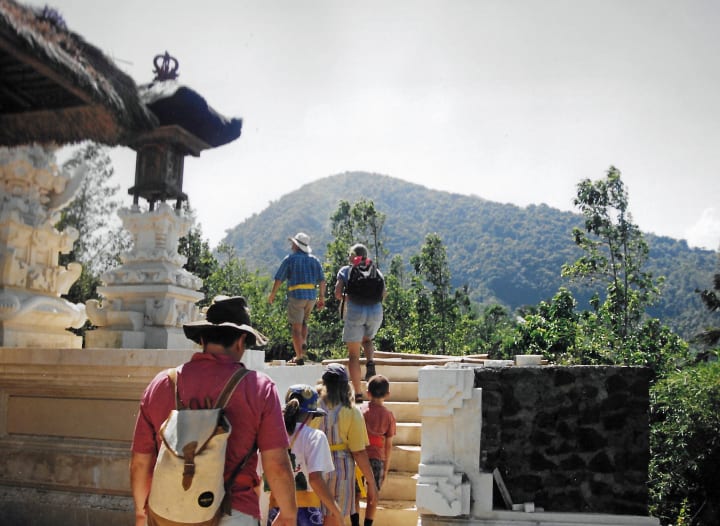
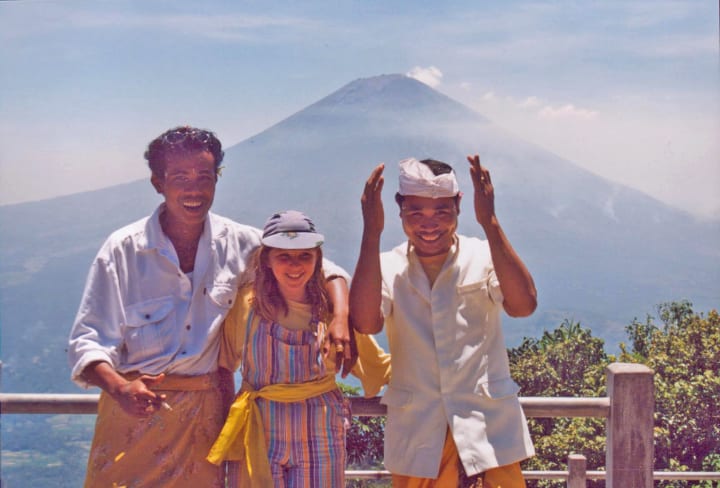
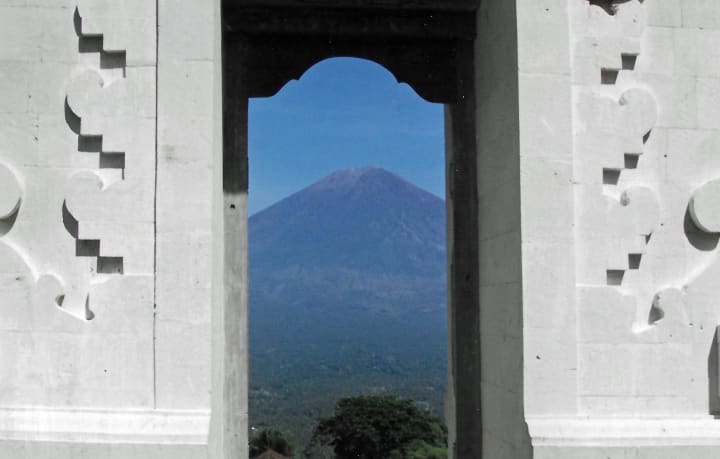
In Bali, we visited the temple of Lempuyang, the eastern mountain facing Mount Agung (the Great Mountain) at the centre of the island. Everything in Bali is oriented towards or away from Mount Agung. Everything closest to Mount Agung is most holy, and everything that faces away, towards the sea, is less holy, or even dangerous. The dead are buried in that direction, and rubbish is thrown the same way.

Also, that’s where the tourists come from.

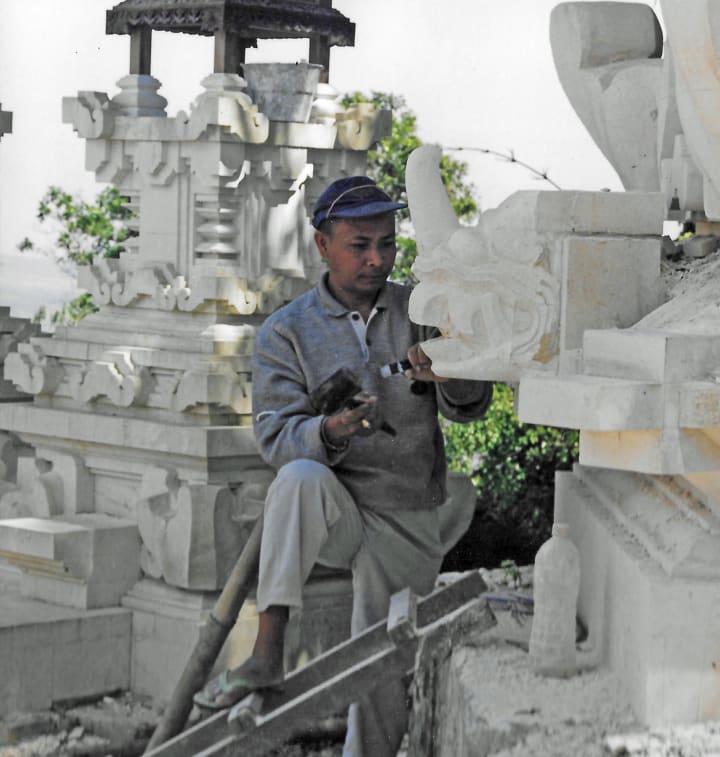
The entry to the Lempuyang complex is on the shoulder of the mountain, where there were stonemasons carving new gates and decorations. The softness of the stone means that artists are constantly employed replacing artwork.

Beyond the entry was the start of the main trail of a thousand steps.

Dragging ourselves up and up to the temple, through the forest, taking respite at the regular shady level rest stops, we were overtaken by local families stepping cheerfully uphill, some with children on their shoulders, some carrying bags of offerings over their shoulders or on their heads. Their fitness and joy was way beyond ours.

We knew enough to bring our temple sashes, but I was quizzed about my “strange hat” – previously a perfectly good straw sunhat that had been squashed into a suitcase and never recovered its original shape. We were also queried about our “dirty friend” – a chatty Frenchman who appeared suddenly from the forest, covered in red mud, having hiked directly uphill from where he left his motorbike without using the ceremonial steps. The volcanic soil of the Balinese mountains is extremely fertile, red coloured and particularly sticky.

The Balinese on the other hand, had washed carefully and dressed in their finest for the climb.

We hastily disavowed having anything to do with the French motorcyclist, notwithstanding my hat was almost as inappropriate as his muddy coating.

At the top of the mountain we emerged into bright sunshine and found a ceremony in progress in the temple. Although I understand Indonesian somewhat, this was in Balinese and I struggled to follow what was happening. There was chanting and singing, and voices overlapping. It seemed very emotional, so we stayed back. The view was spectacular over the green and fertile valleys and the commanding shape of Mount Agung.

We ate our packed lunch of hastily assembled wraps and drank from our plastic water bottles.

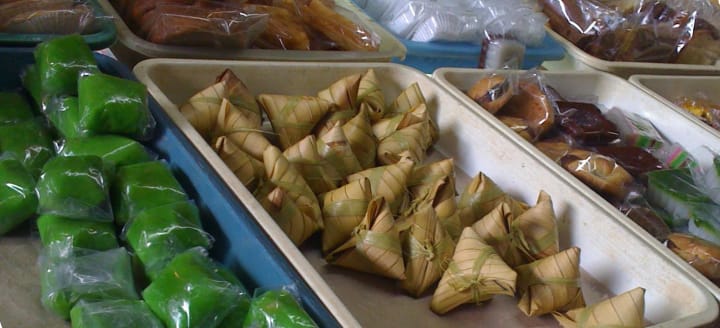
It wasn’t nearly enough. We could have wished for some of the many snacks that are sold at roadside stalls, especially the delicious palm sugar and coconut sweets wrapped in ecologically sound bio-compostable coils of pandanus leaves.

Balinese sweets

However, there were no stalls here, just the temple.

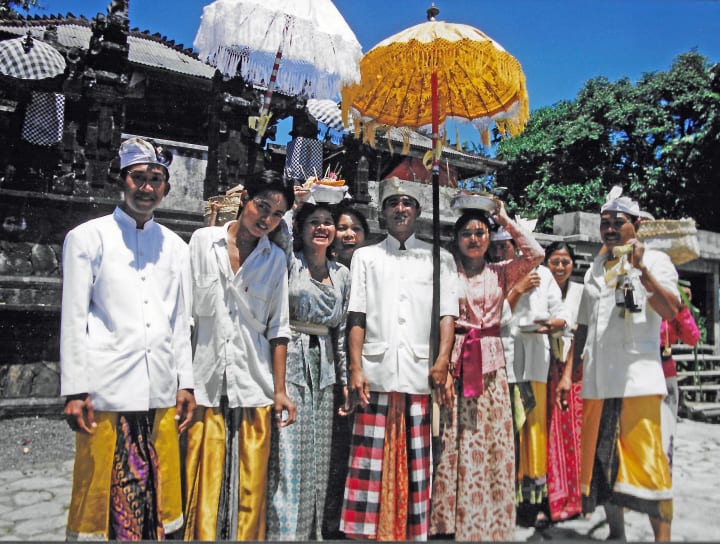
Meanwhile the ceremony had increased further in intensity, with a voice rising into something almost a scream. Suddenly it stopped and people started pouring down the steps of the temple, smiling and laughing with one another.

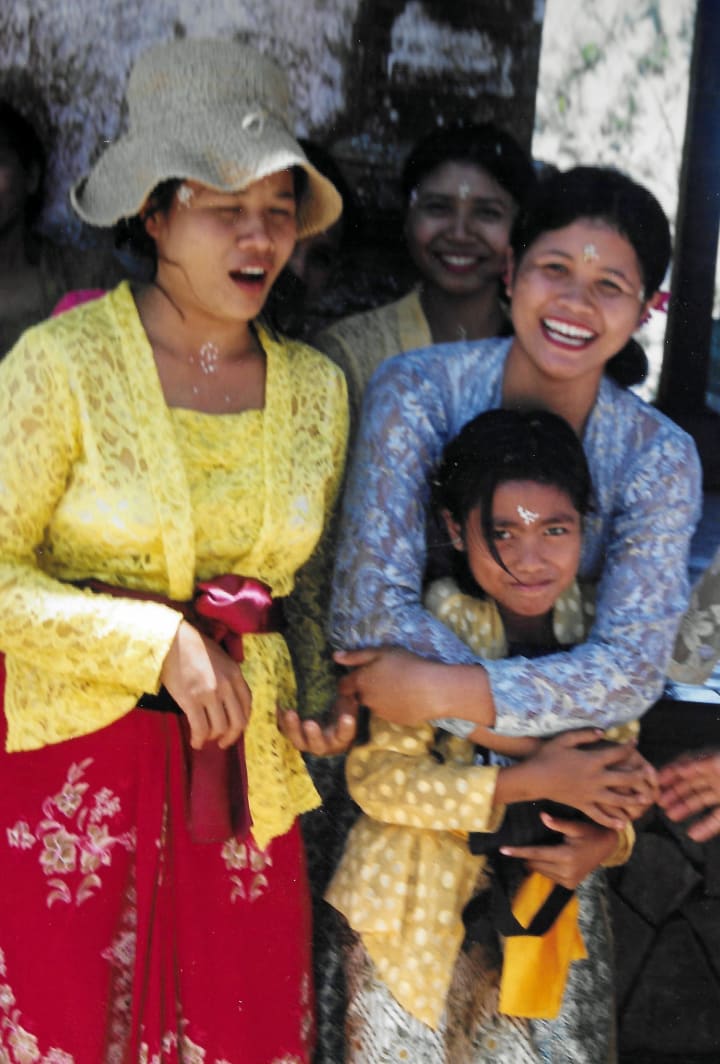
Priest and villagers at Lempuyang

It turned out that the voices we had heard were channelling a beloved grandparent who had promised to be reborn soon, to return to the community. That’s not a given under the Balinese model of reincarnation, as you can be reborn as anything, and not necessarily in the same place. So the whole group was very happy to be welcoming back someone they loved into their own village. We were welcomed as witnesses to such a joyous event.

They immediately started unpacking food parcels (separate from the offerings they’d presented to the temple) and sharing an impressive feast.

We were invited to try different treats from the celebratory food – lots of packets of fish curries and rice wrapped in banana or pandanus leaves, fat Balinese satays of minced meat on sticks with peanut sauce, chopped green beans with coconut oil and galangal in waxed paper. These “lawar” beans I had learned were chopped by the men in a rhythmic ceremony, which makes what would otherwise be a tedious chore (I tried it at home by myself and it was boringly endless) into a fun social occasion. A typically Balinese strategy.

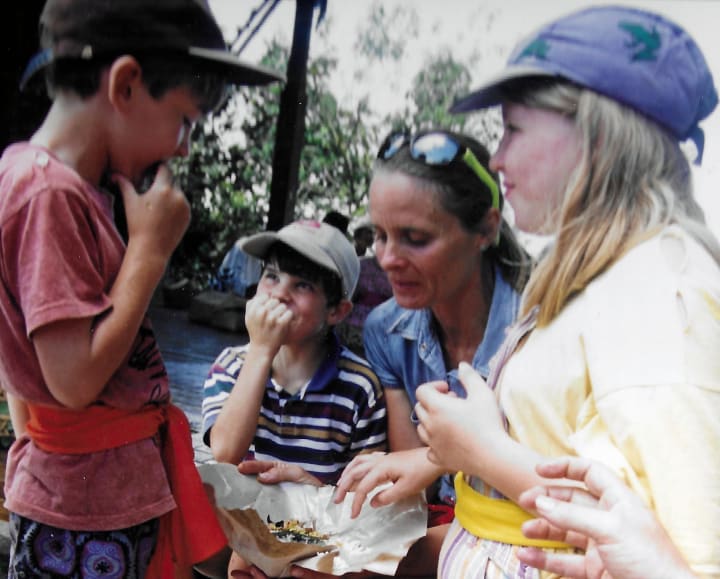
The kids were the most welcomed and treated so kindly – especially Matilda who was given a rare never to be repeated treat – a day-old chick. It was barbecued, whole, on a satay stick. She was slightly taken aback, but game to have a try. We passed it around for everyone to taste.

It tasted like chicken. Hungry as we were, no one ate the beak or the feet.

The locals continued to make fun of my hat.

RECIPE

Kill a day-old chick. Cut out the intestines (very small) but leave the beak and feet.

Stab it with a satay stick.

Barbecue with a sprinkling of galangal and coconut oil. Don’t worry about the fluff, it will burn off.

Garnish with a small amount of chili and fried onion (essential for keeping away bad spirits)

Serve cold, preferably on a mountaintop.

OR A BETTER CHOICE

If you don’t want to barbecue your own chick visit Casa Luna in Ubud for a Balinese cooking lesson, a feast for your senses, which can include visits to the market for ingredients.

Or use Janet DeNeefe’s excellent and definitive Casa Luna Balinese cookbook for a taste of Bali while staying home, as we mostly have to do these days. Of the many spices, Galangal is a key to Balinese flavors, preferably fresh.

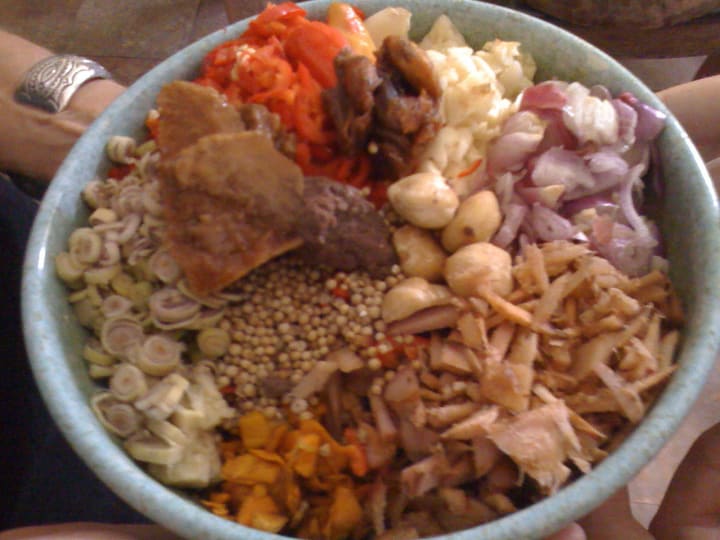
A selection of spices for Balinese cooking

When we went home I tried presenting a Balinese feast for my friends from Janet deNeefe’s recipes, however I made a rookie mistake. I tried to do it all solo. The oil for the corn and galangal fritters spat viciously, the chopping for the lawar beans was endless, I was constantly dodging back to the kitchen for different bits and pieces. To make it even worse, the only sort of galangal I could get was dried and rocklike. When I tried to grind it my blender exploded all over the kitchen.

This type of food needs to be cooked in company with others, as a community, not as an individual. It is far more enjoyable, and you have time to enjoy the spices and the process, the tasting and the sense of achievement.

My homemade feast was delicious, but could not compare to the flavours on the mountain.

A FAMILY FAIRY TALE

Once upon a time there were three children, two boys and a girl, all snuggled up together with their Dad, ready for story time. 

Out comes the book, hardback this time, full of pictures and potential, new and unknown.

The smallest child begins to howl.  “I want Horton the Elephant!  I want Horton!”

Tired-faced Mum comes in from the sneaky cigarette on the back porch. “I’ll take him.”

Dad hands him up and the toddler is carried away squalling, to his own bed and a nightly rendition of “Maizy the Lazy Bird sat on her nest.  She was tired.  She was bored.  She had kinks in her legs.”  Mum and Dr Seuss were back, their brief rest over.   Everyone in the house knew “Horton the Elephant Hatches an Egg” by heart, but the pages were dutifully turned over and the pictures examined.

The other two children wriggled in to see the front page of “The Lion, the Witch and the Wardrobe” by CS Lewis.  Into the forest they go, with four completely unsupervised children who have extraordinary adventures with fauns, lions and wicked witches.

Dad’s voice is deep and resonant, totally unlike Mum’s.  A precious commodity, that voice.  Never says “Can’t you see I don’t have three hands?” or “Can’t you kids be quiet for one minute?” or “Stop that biting!  That means kicking as well. And spitting.”

That deep voice is home for once.  Not at work.  Not out at sea on a ship for months at a time.   Not the distant threat of the jam spoon “When Daddy gets home”.

Here, and reading adventures.  Here, with his scratchy beard and smiling face.  Dad, the fun one, the cavalry arriving in the evening after the children’s dinner for a brief “Goodnight.”

This night he’s here and reading.   Totally forgotten are all the many evenings of stories from Mum, where she patiently reads and re-reads the same stories to each child, getting them tucked in, finding the stuffed Lambie, removing the dog pretending to be a hot water bottle between the sheets, returning with glasses of water for the endlessly thirsty.

This is Dad, reading a story.   The best prize ever. The once and only, and therefore most precious and highly regarded.

But all too soon it’s over.  The book is slammed shut and taken away so that no child can read more under the covers with the flashlight, eyes staring red, grumpy tomorrow, for Mum to deal with. 

The middle child creeps out and checks her closet, just in case there’s something there, perhaps a forest, behind the neatly hanging dresses and jackets, the costume box with Dad’s hilariously huge white tennis shorts and Mum’s torn silk dress from her first dance.  A dress from the days when dancing was her thing, not wiping running noses. 

Lights are off, except in the family room, where Mum and Dad share a glass of wine and the smile that says another day is over without total insanity or a breakdown.

Goodnight, Dad.

Goodnight, Mum.

Goodnight children sleeping in their beds, dreaming of elephants, fauns and wardrobes where a new world waits beyond the spare winter coats. 

Goodnight.

********************

This story was written for a Vocal Media prompt on bedtime stories, but then I was finked by a computer glitch that meant I couldn’t sign in and submit it. Never mind.

Photo by Alex Gorham on Unsplash

A FORGOTTEN FUTURE

Back in 2018 I saw a writing prompt for 1000 word short stories to be set in “A City of the Future”. I believe they had over 1200 entries and put out a book. I wrote a draft of this story at the time, but found it didn’t have a real plot so I abandoned it. That’s an issue with speculative fiction, that you can keep describing the surroundings until there’s no time for character development.

Also, that stories often get abandoned.

Anyway, I found it the other day while looking for something else, and decided I liked it after all, even if it still doesn’t have a proper plot. Maybe it’s the first chapter of a longer story. I don’t know yet. Here it is:

A NEW CHAIR

(Somewhere, fifty years or so from now in a City of the Future.)

Benedetta wanted a strong cup of coffee, but she needed a new chair for Grandma, so she had to go to the FurnitureForest® instead. 

Benedetta also had to take Grandma and the kids along with her.  The kids had been driving their Dad “crazy all morning”, or so he said.

He drove himself into his own crazy when he worked, anyway, she thought.  Half the time he was pushing back his own office chair, leaping to his feet, or waving his arms and shouting at the screen because the data he was analyzing had become corrupted, or included the wrong inputs, or something else trivial.  The energy he put into shouting could have been put into helping out his own mother.  

But Benedetta didn’t bother to argue.

Grandma needed her own chair, and had to come because she must see it first, after all.  Or so she said.

“I’m not staying here alone, anyway” Grandma added. “I don’t trust this house to still be here when we come back.”

It wasn’t very far by the self-driving taxi that Benedetta summoned. 

“I don’t see why you don’t have a car of your own, like you used to,” said Grandma.

Benedetta kept busy shoving the kids into the wide side doors so that she didn’t have to repeat a conversation she’d had too many times.  While it moved silently through the leafy streets, she soon felt like a ping pong ball in a noisy box, what with the kids bouncing against the wall pads, and Grandma telling them to stop it.  As soon as they arrived, the kids jumped out and ran around trying all the chairs until the showroom attendant told them not to.  Grandma tried several armchairs, but none of them were just the right height and shape.   And none of them had the folding footstool she wanted.

The showroom attendant nodded and said “Why don’t you have a look outside in the FurnitureForest® and see if there’s one there that we can adapt to suit you?”

The word “outside” seemed to have a special emphasis.

The kids loved running among the long avenues of growing furniture, turning their head sideways to envision how a group of twigs would twine into a frame to become the back of a chair, and keep pushing upwards to the light to make the seat and legs.

“Here’s one! Look at this one!” they shouted, and pointed to a small sofa with a sinuous back and six sturdy legs.

“Hmm.”  Grandma was not convinced.  “I can’t really understand this new-fangled upside-down furniture.  How can you tell if it’s going to be comfortable when it’s the wrong way up?”

Nevertheless Benedetta pointed at it and told the attendant.  “That one.  We’ll make the legs a little longer than usual so it’s easier to get in and out of.  And I hope you have cushions to fit.”

The attendant clipped away the chair from its frame, with apologies to the growing plants around it.  While they waited in the café having lunch and, at last, the coffee Benedetta had been craving, the sofa was smoothed, given cushions and loaded into the taxi with the kids, Benedetta and Grandma. 

“I must say, I like the way these taxis stretch.” said Grandma as the expansion joints clunked into place, allowing a large floor space between the facing bench seats.  “I’d hate to be in an old-fashioned car with this chair and these kids.”

The kids didn’t notice.  They were too busy trying to see if they could hijack the taxi controls to take them to their favorite ice-cream restaurant, but Benedetta had wisely key-locked the route in the controller.  “I’m not having a repeat of last time” she thought.  That was the time the kids had been fighting over whether they should go to the beach or the mall, with the taxi zigzagging madly every time they changed its orders.  Their Dad thought it was funny.   “Aren’t you glad they’re smart, determined kids?” he asked. 

Benedetta thought she’d have fewer headaches if they were stupider, and quieter.

They swooped through a brand new neighbourhood, one with single room houses perched in the trunks of brand new SuperTrees®.  The old city had been transformed since the development of the ever-growing construction material.   Each house grew rooms as required, then, with the addition of stairs, a single person could move in.  As time went on, more people could buy in with rooms on other branches, or they could add to the original room to grow their own single family home.

Benedetta’s house was in a more established neighbourhood, with the original, practically historic, HouseTrees®.  It was close to the kids’ school, too, which had become its own jungle these days.  Very appropriate, Benedetta always thought.

The kids had wanted a HouseTree® with an internal slide, to drop them at the front steps with a slither and a bump, but Dad pointed out those trees tended to sway more in a high wind due to the loss of internal strength, and make everyone seasick. 

Their own HouseTree® did have a new tower, though, where Benedetta could work, look out across the sea of leaves and watch other people resting in their own branches, high above the ground.

Like rather funny, featherless birds, she thought.    

Downstairs the kids had cajoled their Dad into bringing in the new chair and installing it in Grandma’s room on the lowest level, just off the living room.  The new space still creaked a little from the expensive growth supplement injections that drew the timber around the standard frame.  Six weeks ago the room had been little more than a thread of narrow twigs, but hourly they had thickened and joined into a cosy space, ready for the window and the rug, and now the chair.  The bed frame was shaped as a shelf out from the wall, and the mattress was a spare one Benedetta kept for visitors.  Only a few knickknacks had come with Grandma from her old-fashioned house on the ground.  She had to leave everything else behind because of the flooding. 

With the touch of a button the spring-loaded footstool folded outwards and Grandma sank into the comfortable mossy cushions. 

“Well, this is all right.” She said.  “I suppose this treehouse will do for now.”

“At last” thought Benedetta, “She’s satisfied.”

There had been long days of arguments persuading Grandma that she would be happy joining them in their big HouseTree®.  “I don’t want it to swallow me up one night” she’d complained.  “Or drop me on the ground.  I don’t trust it”.

Benedetta had patted the trunk and thanked it for its sturdy service, hoping it couldn’t hear the insults, even though she knew it couldn’t really hear the words.

The kids careered away to play among the huge buttresses down at the base.  “Don’t dig into the roots!” Benedetta shouted down to them “You don’t want your playroom to go rotten”.  Their neighbours had made the mistake of disturbing the growth zone underground their home, and the rotten unsafe branch it caused not only made an ugly gap in the floor, but also displayed the piping that fed the kitchen and bathroom waste into the root zone.  The smell was awful.

Now, the kids swung happily on the lowest branches. 

Dad had stopped shouting at his screen.

Grandma rocked happily in her new chair. 

Benedetta swayed in her tower, her headache long gone.

“This is all right” she said.  “This is the life.”

A PLAGUE OF WORDS

Fear in the eyes

Taunts and lies

Threats and show

A new low

How far can we go?

Who guards the words?

Meaning flown like birds

Blue and green or grey or skies

How can we turn all that to lies?

Peace and kindness, work or truths,

Stealing the words out of our own mouths

Changing all to weapons of war

Angry to the core

Fear in the eyes

Plagued by lies